
The journal · 19 November 2026
Guru Nanak Jayanti 2026: Date, Kartik Purnima Tithi & Why November
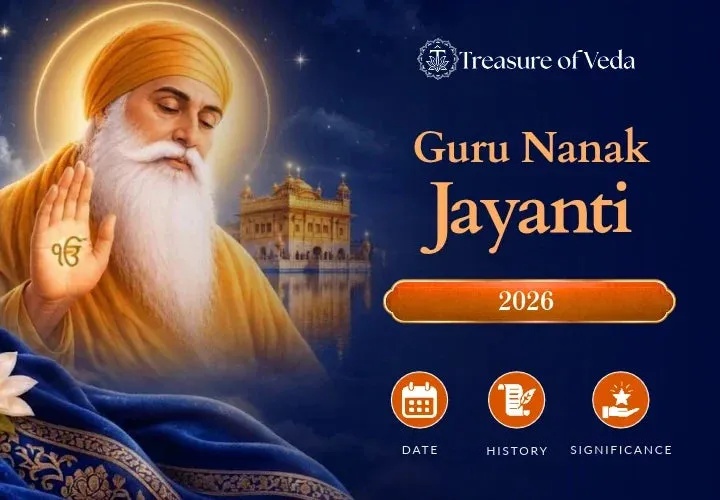
Many sources give Guru Nanak Dev Ji's birth date as 15 April 1469, yet Sikhs celebrate his birthday in November. Why?
Quick answer: Sikh tradition marks Guru Nanak's Prakash Purab on Kartik Purnima, the full moon of the lunar month of Kartik. Because the date follows the moon, it moves every year. In 2026, Guru Nanak Jayanti falls on Tuesday, 24 November 2026, and it is a central government holiday. The April date comes from a different set of early records, and the community holds both traditions.
When Is Guru Nanak Jayanti in 2026? Date, Purnima Tithi Time & Holiday
|
Detail |
2026 |
|
Festival |
Guru Nanak Jayanti / Gurpurab / Prakash Purab |
|
Date |
Tuesday, 24 November 2026 |
|
Occasion |
557th Prakash Purab of Guru Nanak Dev Ji |
|
Kartik Purnima tithi begins |
11:42 PM, Monday, 23 November |
|
Kartik Purnima tithi ends |
8:23 PM, Tuesday, 24 November |
|
Central government holiday |
Yes (gazetted) |
Timings follow Drik Panchang for New Delhi and shift by a few minutes elsewhere. Each gurdwara announces its own programme times.
A tithi does not start at midnight the way a calendar date does. Purnima begins late on 23 November and is in force at sunrise on the 24th, so the festival belongs to the 24th.
"Guru Nanak's Birthday" is on the Government of India's 2026 gazetted holiday list, and central government offices are closed. States, schools and banks publish their own lists, so check your state's notification.
Why does the date change every year? The festival follows the lunar calendar, and lunar months do not line up with the solar year. It fell on 15 November in 2024 and 5 November in 2025. This year it is 19 days later than last year's date.
Why Is Guru Nanak's Birthday Celebrated in November?
Because Sikh tradition marks it on Katak Pooranmashi, the Kartik full moon, which falls in October or November. No single decree fixed this. The date passed through traditional life accounts of the Guru and then through the calendars later Sikh institutions published.
Both major institutions agree on it. The Shiromani Gurdwara Parbandhak Committee (SGPC) records the birth as 15 April 1469 but holds the anniversary on Kartik Purnima. Nankana Sahib in Pakistan, the Guru's birthplace, also hosts its main Gurpurab celebrations in November.
Was Guru Nanak Born in April or November?
Two traditions sit side by side, and both appear in the community's own writing.
-
The April (Vaisakh) record. The Puratan, Miharban and Vilayat Vali janamsakhis, and Bhai Mani Singh's Gyan Ratnavali (1712), place the birth in Vaisakh, usually converted to 15 April 1469. Historians such as Macauliffe, Hew McLeod, Kahn Singh Nabha and Khushwant Singh accept the Puratan account. Karam Singh argued the case in Katik ke Baisakh (1913).
-
The November (Kartik) tradition. The Bala Janamsakhi records a Kartik birth, and later works such as Gurbilas Patshahi 6 (1718) and Nanak Prakash (1823) follow it. Critics note that the Bala text is later than the Puratan tradition. Even a SikhNet essay favouring April concedes that tradition is strong for Kartik, and that the celebrations continue in that month.
-
The calendar angle. The Nanakshahi calendar, designed by Pal Singh Purewal and adopted by the SGPC in 2003, tried to fix Gurpurab dates to the solar year. The SGPC amended it in 2010, and the Akal Takht endorses the amended version. Pakistan's Gurdwara committee and some other bodies follow the original. A minority following the original ("Mool") calendar mark the birth on 14 April.
Present both views with respect. Neither community nor scholars treat the other as wrong.
Gurpurab vs Guru Nanak Jayanti vs Prakash Utsav
Gurpurab is the general word for any anniversary tied to the ten Gurus. Guru Nanak Jayanti is the popular name for Guru Nanak's birth anniversary, used by calendars and news outlets. Prakash Utsav, Prakash Purab and Prakash Parv are the Sikh terms for the same day. Prakash means light.
Significance of Guru Nanak Jayanti
Guru Nanak Dev Ji (1469–1539) founded the Sikh faith and is the first of the ten Gurus. He was born at Rai Bhoi di Talwandi, now Nankana Sahib, and spent his later years at Kartarpur. His teaching rests on one idea and three practices:
-
Ik Onkar: one Creator, present in all.
-
Naam Japna: remember the divine Name.
-
Kirat Karni: earn an honest living.
-
Vand Chakna: share what you earn.
Langar, the free community kitchen where everyone eats the same meal side by side, puts these teachings into practice.
How Sikhs Celebrate Guru Nanak Jayanti
Each gurdwara announces its own schedule. The traditional order is:
-
Prabhat Pheris: dawn processions singing shabads, in the days before.
-
Akhand Path: a continuous 48-hour reading of the Guru Granth Sahib, timed to finish on the morning of Gurpurab.
-
Nagar Kirtan: a procession the day before, led by the Panj Pyare with the Guru Granth Sahib on a decorated palanquin.
-
Gurpurab morning: Asa di Var, kirtan, katha, Ardas and Karah Prasad.
-
Langar and evening lighting: a free meal for everyone, and gurdwaras and homes lit with lamps.
Gurdwara Janam Asthan at Nankana Sahib is the focal point of the pilgrimage. Indian Sikhs travel there in jathas under India–Pakistan shrine-visit agreements, and approval depends on both governments each year, so check SGPC announcements for this year's status.
Kartik Purnima 2026: The Same Day for Hindu Devotees
Guru Nanak Jayanti shares its date with Kartik Purnima, which Hindus observe as Dev Deepawali and Tripurari Purnima. Tradition links the day to Lord Shiva's victory over the demon Tripurasura, after which the gods are said to have lit lamps in celebration. Devotees take a holy bath at rivers (Kartik snan), offer lamps (deep daan) and give in charity.
This is a separate observance from the Sikh Gurpurab, which centres on kirtan, the Guru Granth Sahib and langar. The two share a date because both follow the same full moon.
For devotees who mark Kartik Purnima with Shiva worship, many choose this day to begin or renew wearing a Rudraksh, the bead traditionally associated with Lord Shiva. If you are looking for one, Treasure of Veda lists energised and certified beads in its Rudraksh collection. Those drawn to the Vedic astrology tradition of gemstones can browse the gemstones collection. These are devotional and traditional practices, and not guaranteed outcomes.
If you are unsure which Rudraksh or stone suits you, the store offers a personalised gemstone consultation before you buy.
Conclusion
Guru Nanak Jayanti 2026, observed on Tuesday, 24 November, brings together centuries of historical tradition and living devotion. While historical records preserve both the April (Vaisakh) and November (Kartik) dates, the global Sikh community continues to unite around Kartik Purnima to honour the 557th Prakash Purab of Guru Nanak Dev Ji. Beyond the calendar dates, the heart of the day remains unchanged: reflecting on Ik Onkar, practising honest living, and sharing through seva and langar—values that shine just as brightly today as they did over five centuries ago.