
The journal · 13 November 2026
Chhath Puja 2026: Dates, Meaning, History, Vidhi & Rules
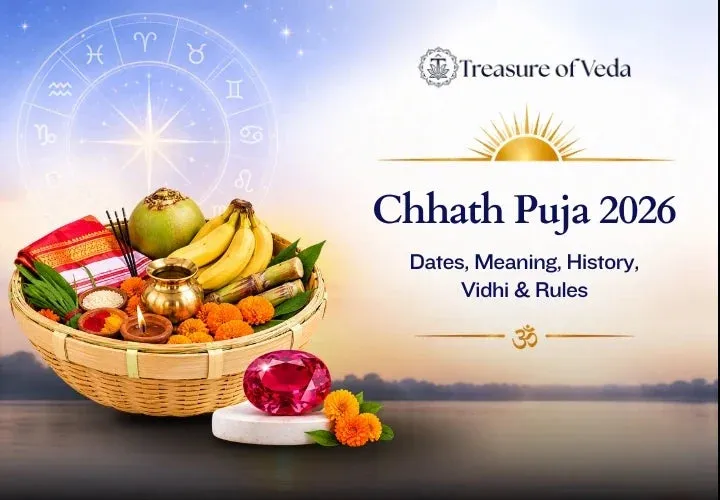
What is Chhath Puja, and why do millions of people stand waist-deep in cold water at sunset to thank the Sun? The answer sits in one of the oldest living traditions of Surya worship, one that needs no idol, no temple and no priest. This guide gives you the 2026 dates and timings, the story of Chhathi Maiya, the full four-day vidhi, the samagri list, the rules, and an honest look at the science claims.
In short: Chhath Puja is a four-day festival in which devotees worship Surya Dev and Chhathi Maiya with a waterless fast of about 36 hours and offerings of water to the setting and rising Sun. In 2026 it runs from Friday 13 November to Monday 16 November. The main day, Sandhya Arghya, falls on Sunday 15 November, and the fast ends after Usha Arghya at sunrise on Monday 16 November.
Chhath Puja 2026 at a Glance: The 4 Days
|
Day |
Name |
Date (2026) |
What happens |
|
1 |
Nahay Khay |
Friday, 13 November |
Holy bath, a cleaned home, one pure meal |
|
2 |
Kharna (Lohanda) |
Saturday, 14 November |
Day-long fast, broken after sunset with jaggery kheer and roti; the waterless fast begins |
|
3 |
Sandhya Arghya |
Sunday, 15 November |
Offering to the setting Sun, standing in water |
|
4 |
Usha Arghya and Parana |
Monday, 16 November |
Offering to the rising Sun; the fast is broken |
What Is Chhath Puja and Why Is It Celebrated?
Chhath Puja is a Vedic-rooted festival dedicated to Surya, the Sun, and to Chhathi Maiya, the goddess who protects children. The name comes from chhath, meaning "sixth": the main rites fall on Shashthi, the sixth tithi of the bright fortnight of Kartik. Other names for the festival are Surya Shashthi, Chhath Parv and Dala Chhath.
Devotees keep it to thank the Sun for sustaining life and to pray for the health of their children and the wellbeing of the whole family. The ritual is public and bare: the devotee, called a vratin or parvaitin, stands in a river, pond or tank and offers water, fruit and prasad directly to the Sun. Rich and poor stand in the same water and make the same offering, which is why many people describe Chhath as the most egalitarian festival in the calendar.
In Jyotish, the Sun is the Atmakaraka, the significator of the soul, and it governs vitality, authority and the father. That is why a Sun festival is also a health festival in tradition. Students who study Jyotish in a vedic astrology course in india learn to read the Sun by sign, house and dasha, and they see quickly why this one graha anchors an entire festival.
When Is Chhath Puja in 2026? (Date, Muhurat and Arghya Timings)
Chhath Puja 2026 begins with Nahay Khay on Friday 13 November and ends with Usha Arghya on Monday 16 November. The two arghya moments are fixed by your own city's sunset and sunrise, not by a national clock.
The tithi logic is simple. According to Drik Panchang, Panchami ends at 11:23 PM IST on Saturday 14 November, and Shashthi then runs until about 2:00 AM IST on Monday 16 November. Shashthi therefore holds at sunset on Sunday 15 November, so the evening arghya falls that day. Reading a panchang this way is a core skill in anyvedic astrology diploma course, because every festival date rests on the tithi that prevails at a particular moment.
Arghya timings in major Indian cities (IST, from Drik Panchang):
|
City |
Sandhya Arghya (sunset, 15 Nov) |
Usha Arghya (sunrise, 16 Nov) |
|
Patna |
5:01 PM |
6:07 AM |
|
Ranchi |
5:04 PM |
6:03 AM |
|
Varanasi |
5:10 PM |
6:16 AM |
|
Kolkata |
4:53 PM |
5:50 AM |
|
Delhi |
5:28 PM |
6:44 AM |
|
Mumbai |
6:00 PM |
6:46 AM |
Different calendars show a difference of a minute or two for the same city. Families usually reach the water 30 to 60 minutes before sunset, so confirm the time with your local ghat committee or panchang on the day.
A caution on dates: some websites still list Chhath in October 2026. That is wrong for this year. The correct window is 13 to 16 November.
Why Is Chhath Puja Celebrated Twice a Year?
Chhath is observed twice a year: Chaiti Chhath in the month of Chaitra (March-April) and Kartik Chhath in Kartik (October-November). Both are kept on Shukla Shashthi, and both follow the same four-day pattern. Kartik Chhath is the large festival that fills the ghats of Bihar, Jharkhand and eastern Uttar Pradesh. Chaiti Chhath is observed on a much smaller scale.
The sources I reviewed do not give one agreed scriptural reason for the two dates, so treat any single explanation with caution. What is clear is the calendar logic: the same Shukla Shashthi vrata is kept in two different lunar months. That month, paksha and tithi logic is the same system you learn in aself-paced Vedic astrology course with lifetime access a lunar month, a paksha, a tithi, and the rule that the tithi at the right moment decides the day.
Is Chhath Puja Only Celebrated in Bihar?
No. Chhath began in the Bhojpuri, Magahi and Maithili regions and is kept most intensely in Bihar, Jharkhand, eastern Uttar Pradesh and the plains of Nepal. Migration has carried it far beyond.
Delhi, Mumbai, Kolkata and other large cities have thousands of temporary ghats on Chhath evenings, and the diaspora observes it in the United States, the United Kingdom, Canada, Australia, the UAE, Singapore, Mauritius and elsewhere. In places without rivers, communities use lakes, tanks or artificial ponds arranged by local samitis.
Who Is Chhathi Maiya? (The Chhath Mata Story)
Chhathi Maiya is the goddess worshipped alongside Surya during Chhath, and she is understood as the protector of children and giver of long life. She is identified with Shashthi Devi, and the Brahma Vaivarta Purana describes her as the sixth part of Prakriti, the creative nature principle. In the same tradition she is called Devasena and described as the mind-born daughter of Brahma. Folk tradition, especially in Bihar, calls her Surya's sister. A third view links her with Usha and Pratyusha, the dawn and dusk lights, which fits a festival built around sunrise and sunset.
Some writers equate Chhathi Maiya with Katyayani, the sixth form of Durga worshipped in Navratri. Others keep the two distinct, and families follow their own lineage on this point.
The story of King Priyavrata. The best-known story, drawn from the Puranic tradition, concerns King Priyavrata, son of the first Manu, and his queen Malini. The couple had no child. After a yajna conducted by the sage Kashyapa, the queen bore a son, but the child was stillborn. As the grieving king prepared to give up his life, a radiant goddess appeared and said she was Shashthi, who protects all children. She revived the child and asked the king to spread her worship. Priyavrata observed her vrata on Kartik Shukla Shashthi, and the tradition says this is the root of the day's observance.
Why Is Surya Dev Worshipped in Chhath Puja?
Surya is worshipped because the Sun is the one deity everyone can see, and every living thing depends on it. In the Vedic view the Sun is the visible form of the divine, the source of light, food, seasons and time itself. Chhath turns that idea into a direct act: no image stands between the devotee and the Sun.
One feature separates Chhath from nearly every other Sun observance. The first major arghya goes to the setting Sun, not the rising one. Most traditions honour the dawn, the symbol of growth. Chhath honours the day's close first, and only then the new sunrise. The teaching reads clearly: gratitude covers the fading and the rising alike, the whole arc of the day and the whole arc of a life.
In Jyotish, the Sun signifies the soul, the father, vitality, the eyes and the heart. A weak or afflicted Sun in a chart is classically linked with low vitality, strained relations with the father, or difficulty gaining recognition, and Sun worship is a traditional remedy. Water also enters the picture, since the Moon rules water and the mind, so standing in a river brings both luminaries into the rite. For a deeper look at how the Sun behaves in a birth chart, see [LINK: Sun in Vedic Astrology: Surya's Role in the Birth Chart].
Which Rudraksh Should You Wear During Chhath Puja?
The 12 Mukhi (twelve-faced) Rudraksh is the one traditionally linked with Surya, so it is the usual choice for Sun worship during Chhath. The 1 Mukhi Rudraksh is also associated with the Sun and with Shiva, though it is rare and costly, and many people choose the 12 Mukhi instead.
Chhath Puja itself does not require any Rudraksh. The vrata rules, the fast, the arghya and the prasad are complete without it, and the sources I reviewed list no Rudraksh among the samagri. The Sun association comes from Jyotish and Rudraksh tradition, so wearing one is a personal choice, not a ritual rule.
If you decide to wear one:
-
Wear it on a clean cord or in a mala, after bathing, and keep the same purity you keep for the vrata: no onion, garlic, meat or alcohol.
-
Begin on a Sunday, the Sun's day, or from Nahay Khay, and chant "Om Suryaya Namah" or the Surya Gayatri.
-
Take off a Rudraksh for any situation your family tradition treats as impure, and store it clean.
-
Buy only a genuine bead and confirm the mukhi count before you pay.
Tradition advises having your birth chart read first, because a bead or stone that suits one chart may not suit another. No Rudraksh replaces the discipline of the vrata or guarantees a result.
You can browse Rudraksh, bracelets or Ruby and other Vedic gemstones. Ruby (Manik) is the Sun's classical gemstone.
Chhath Puja History: What the Mahabharata, Ramayana and Vedas Say
Tradition traces Chhath to the earliest Surya worship of the Vedic age, when sages are said to have kept long fasts and invoked the Sun with Rigvedic hymns. The Rigveda does contain hymns to Surya, and the structure of Chhath, standing in water and offering to the Sun, belongs to that old family of rites. Specific Chhath legends then come from the epics and the Puranas.
The Mahabharata connection
Several threads run through the Mahabharata. Kunti is said to have kept the vrata after the Pandavas escaped the house of lac. Karna, the son of Surya and Kunti, is remembered as a devotee who stood in water each day to offer arghya to his father, and the Anga region he ruled corresponds to the Bhagalpur area of Bihar. Draupadi and the Pandavas are said to have observed Chhath during their years of hardship, on a sage's advice, to regain what they had lost. A village called Nagdi near Ranchi preserves a local belief that Draupadi worshipped there, and the festival is held at a spring rather than a river.
The Ramayana connection
In the Ramayana tradition, Rama and Sita fasted and worshipped the Sun on Shashthi after their return to Ayodhya, and Sita is said to have kept the Chhath vrata. Local traditions name places tied to her: the Sitacharan site on a rock in the Ganga at Munger, and the Narayani river banks in the Champaran and Chitwan region, where Sita is believed to have stayed at Valmiki's ashram.
Other accounts name Buxar as the place of Surya's birth to Aditi on this very day, and credit the Gahadavala rulers with spreading the festival from Varanasi. These regional accounts differ, and each family keeps the story its elders told.
Why Is Chhath Puja Not Performed in Temples? Which Water Body Is Used?
Chhath is not performed in temples because it needs no image, no priest and no enclosed shrine. The deity is the Sun itself, and the proper place to worship it is open ground at the water's edge. The devotee makes the offering directly, without an intermediary.
Any clean, flowing or large body of water works: a river such as the Ganga, a pond, a lake, a canal or a village tank. Where none exists, communities build temporary tanks, and some families use a clean tub or a backyard pool. Water is the point because the arghya is poured as the Sun's light touches it, and because standing in water is a mark of surrender and discipline.
Sun temples do exist, such as the Deo Surya Mandir in Aurangabad, Bihar, and some ghats have shrines nearby. The Chhath rite itself, however, does not depend on them.
Chhath Puja Vidhi: The 4 Days Step by Step
Day 1: What Is Nahay Khay in Chhath Puja?
Nahay Khay, "bathe and eat", begins the vrata. The vratin takes a holy bath, ideally in a river, and the entire house and kitchen are cleaned. One sattvic meal is cooked without onion or garlic, usually bottle gourd (lauki) with chana dal and rice, often using rock salt. It is offered first and then eaten by the vratin, and the rest of the family eats afterward. This is the last full meal before the long fast.
Day 2: What Is Kharna in Chhath Puja?
Kharna, also called Lohanda, is a day-long fast. After sunset the vratin worships and eats rasiao, a kheer of rice, milk and jaggery, with roti. Many families cook it on a fresh clay stove with mango wood and prepare it without salt. The prasad is eaten quietly and then shared with family and neighbours. After this meal the waterless fast begins.
Day 3: What Is Sandhya Arghya?
Sandhya Arghya is the main day. The day goes into preparing thekua and arranging the bamboo soop and daura. In the late afternoon the family walks to the ghat, often with the daura carried on the head and Chhath songs sung along the way. The vratin stands in the water and offers arghya, water or milk, while the soop of fruit and prasad is raised toward the setting Sun.
At home that night, many families perform kosi bharai: five to seven sugarcane stalks are tied into a canopy, and twelve to twenty-four diyas are lit beneath it with thekua and fruit placed inside. The same rite is repeated before dawn.
Day 4: What Is Usha Arghya?
Usha Arghya is the offering to the rising Sun. The family returns to the ghat before sunrise, and the vratin offers arghya and prays to Chhathi Maiya for the children and the household. Then comes parana: the vratin breaks the fast with a little prasad and water, and the prasad is shared with everyone present.
Why Do Women Fast for 36 Hours in Chhath Puja?
Women, who are the most common vratins, fast because Chhath is a vow made for the wellbeing of their children and family, and the severity of the vow is part of the offering. The fast runs from after the Kharna meal on Saturday evening until parana on Monday morning, which comes to roughly 36 hours without food or water. The austerity, the cold-water standing and the long wait for the sun are understood as tapas.
Men also keep the fast, and Chhath is not a gender-restricted festival.
A health note. A waterless fast of this length carries real risk. Pregnant or breastfeeding women, people with diabetes, heart, kidney or blood pressure conditions, older people, and anyone on regular medication should speak to a doctor first. Children should join the arghya without fasting. Tradition itself allows a modified fast, or a family member keeping the vrata on another's behalf. If a vratin feels faint, confused or has chest pain, stop the fast and get medical help.
Chhath Puja Samagri List
Prepare these before Nahay Khay so that nothing is missing on the day.
Core items
-
Soop, the bamboo winnowing basket on which the prasad is raised
-
Daura or dauri, the deep bamboo basket that carries everything to the ghat
-
Thekua and kasar laddu (rice flour and jaggery)
-
Sugarcane stalks with their leaves
-
Bananas, coconut, sweet lime or citron, water chestnut, sweet potato, radish
-
Whole turmeric and ginger plants with leaves, if your family's custom includes them
-
Diyas, ghee and cotton wicks
-
A copper, brass or steel lota or kalash for the arghya water or milk
Puja items
-
Rice, sindoor, flowers, betel leaf and supari, incense
-
Ganga jal, if available
-
New or freshly washed clothes: commonly a cotton sari for women and a dhoti for men
For Kharna
-
Rice, milk, jaggery and wheat flour for the rasiao kheer and roti
Bamboo soops and dauras are sold in markets before the festival. Abroad, many families use a clean steel plate or a wicker tray when bamboo is unavailable.
What Is Thekua Prasad Made Of?
Thekua is the signature prasad of Chhath. It is a crisp, sweet cookie made from whole wheat flour, jaggery and ghee. Many families add dry coconut, cardamom or fennel seeds. The dough is pressed into a wooden mould called a saancha and fried slowly in ghee until golden brown.
Other traditional offerings sit beside it. Kasar is a laddu of roasted rice flour and jaggery. Rasiao is the jaggery kheer eaten at Kharna. Some regions add rice laddus filled with coconut and jaggery, and the soop carries seasonal fruit. Everything is vegetarian and prepared without onion or garlic, and the person cooking does not taste the food while making it.
What Are the Rules of Chhath Puja? (Do's, Don'ts and Eligibility)
Do's
-
Keep the home, kitchen and path to the ghat clean throughout the four days.
-
Cook prasad separately, often on a new clay stove with mango wood.
-
Use natural, biodegradable materials such as bamboo, clay diyas and leaf plates.
-
Offer arghya exactly at your local sunset and sunrise.
-
Break the fast only after Usha Arghya, and share the prasad first.
Don'ts
-
Do not bring onion, garlic, meat, eggs or alcohol into the house for the four days.
-
Do not taste the prasad while cooking it.
-
Do not touch the offerings without bathing and purifying yourself first.
-
Do not take plastic, polythene or synthetic items to the ghat or into the water.
-
Do not drink water during the nirjala stretch unless your health requires it.
Can men observe the Chhath Puja fast?
Yes. Women are the majority of vratins, but Chhath is not restricted by gender, and many men keep the full vrata.
Can unmarried girls do Chhath Puja?
The sources I reviewed give no firm rule either way. The vow is usually taken for the family and children, so practice varies by household and region. Follow your own family's custom and ask your elders.
What happens if Chhath Puja is missed or the fast is broken?
Families differ. In some communities, once a household takes up Chhath it keeps it every year, skipping only when there is a death in the family, and stopping for a year may end the observance permanently. Other communities treat it as optional. If the fast is broken by accident, families commonly consult their elders or family priest about the correct way to continue. Health always comes first: if you must drink water or eat for medical reasons, do it, and the tradition allows another family member to keep the vrata on your behalf.
Is There a Scientific Reason Behind Chhath Puja?
Many popular articles claim Chhath boosts immunity, absorbs solar energy, detoxifies the body and slows ageing. Those claims are repeated widely, but the sources behind them do not show controlled studies, and this guide does not treat them as proven.
What can be said with confidence is more modest and still substantial:
-
Sunrise and sunset timing. The ritual falls at dawn and dusk, when sunlight is gentle. Vitamin D synthesis needs stronger UV, which arrives at midday, so the timing is about devotion and discipline, not about Vitamin D.
-
Ecology. No idols are immersed, and the materials are bamboo, clay, fruit and leaves. This makes Chhath one of the lowest-waste festivals in the Hindu calendar, and many communities clean the ghat together before the puja.
-
Community and mental health. Shared preparation, folk singing and collective effort strengthen social bonds, and gratitude practice has recognised benefits for wellbeing.
-
Fasting and cold water carry risk. They are physical stressors, which is why the health note above matters.
Treat Chhath as a spiritual discipline with ecological and social value, not as a medical treatment.
Chhath Puja Songs and Folk Traditions
Chhath geet, the folk songs of the festival, are sung in Bhojpuri, Maithili and Magahi while making thekua, walking to the ghat and waiting for the Sun. They speak of the bamboo basket bending under its offerings, the mother's vow, and the request for her family's wellbeing. The late Sharda Sinha made many of these songs known far beyond Bihar, and her voice is still tied to Chhath for millions of listeners. Listen to the versions your family already sings, because the tune often changes from village to village.
Final Thoughts
Chhath Puja 2026 asks for four days of discipline: a clean home, a pure kitchen, a long fast, and a quiet offering to the Sun at the day's close and its return. Whether you keep the vrata, support a family member who does, or simply stand at the ghat, the festival teaches the same lesson. Gratitude belongs to both the setting and the rising Sun. Happy Chhath Puja to you and your family